
In our introductory blog last month, Shelford Group Managing Director Will Warburton and Policy Fellow Katie Badcock talked about the Trusts’ role as anchor institutions, taking a broader view of the role they play in improving the health and wellbeing of their local populations.
In this follow-up Dr Bob Klaber, Consultant Paediatrician and Director of Strategy, Research and Innovation at Imperial College Healthcare NHS Trust (ICHT), and Chair of the Shelford Strategy Directors subgroup, talks about the work ICHT has undertaken in this area over his 15 years at the Trust. This blog originally featured on the Health Anchors Learning Network website as a guest article.
Being part of Anchor Collaborations means taking a wider view than we perhaps have historically on the role of large hospital trusts in improving health in their community. How are you thinking about the role of Imperial College Healthcare differently as a result?
Throughout the 15 years I have been at Imperial, we have had a strong focus on achieving the highest quality of care for every patient. But you only have to look at the level of health inequalities that exist within the population who live in the communities around our hospitals to see that this ethos must extend outside the hospital walls if we are to maximise our impact on health and wellbeing.
The work of organisations such as the RUSH University Medical centre in Chicago in the US has inspired us – their five-point framework highlights the role organisations like ours can take as anchors and how this provides a portal through which we can develop programmes that tackle such inequalities. We also think this idea can be further extended to address some of today’s major challenges for the healthcare system such as the recruitment and retention of our health and care workforce, and elective recovery.
I’m really clear that a sense of organisational humility and collaborative partnership working with local government, communities, patients, universities, and other external organisations will be absolutely essential here – we are part of a much bigger whole, and there are people out there who have experience and expertise that we need to be listening to much more than we might have done in the past.
Like many large urban areas, North-West London has significant differences in health outcomes across its local area. Can you give us a practical example of where you expect taking an anchors approach will make an impact on inequalities locally?
The exciting thing about this agenda is that the number of examples is growing! On workforce, for example, we have insourced over 1,000 cleaning, portering, and catering staff providing enhanced employment benefits to valued staff who increasingly come from our local communities. We also see that we have a role in terms of sustainability and environmental impact. Many of our patients and staff are also local residents, so we are teaming up with our local council’s sustainability teams to work together on key projects within our Green Plans, as well as leaning on the expertise of our academic partner, Imperial College London, on this agenda.
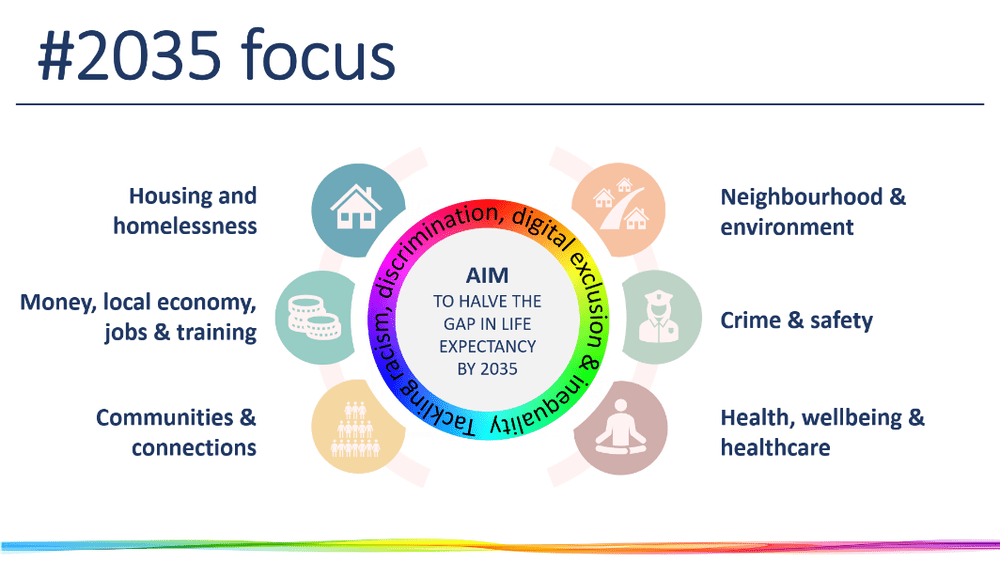
Our #2035 project has been developed with the core aim of halving the gap in life expectancy across the borough of Westminster by 2035. The work started with community-led research that asked members of the community about the things that really mattered to them. Adopting an anchors approach, we are now working in partnership with our local communities, local agencies and other partners to co-design interventions in 7 areas of focus that we believe will affect the greatest change. This work also provides a brilliant opportunity of involving staff who are also local residents as change agents within their local communities.
From July, Integrated Care Systems will be formally established, with one of their four target goals being ‘helping the NHS support broader economic and social development’. What potential do you see from the development of ICSs to further this agenda?
The most obvious benefit arising from the development of ICSs in driving the anchors mission forwards is the opportunity to strengthen partnerships with local government and other health and social care organisations within our locality.
The decades of experience of economic and social development possessed by local government officers and councillors places them as essential partners in the development of effective practical solutions to address inequalities within our communities. I’d emphasise again the importance of deep organisational humility and curiosity as well as the investment of time and resource in nurturing and strengthening these working relationships – that’s going to be essential if we are to achieve our mission.